
- Content Marketing
- GEO
- SEO
B2B SaaS Content Strategy for LLM SEO: A New Expert Guide
Learn how to build SaaS content that ranks in LLMs and drives signups.


If you’re reading this, chances are you’ve been asking yourself at least one of the following:
- How do I build a successful SaaS content marketing strategy that actually drives pipeline, not just traffic?
- What’s changed in SEO now that ChatGPT, Claude, and other LLMs are becoming the first stop for B2B buyers?
- Is my current content even visible to these models, and how do I know?
I’ve had these same conversations with lots of B2B SaaS companies over the past year. Smart, well-funded companies with product–market fit and strong marketing execution, but who still struggle to turn content into signups or visibility. The reason is that they’re still optimizing for Google, despite a rapid shift to LLM-driven discovery.
In this SaaS content marketing guide, I’ll walk you through how to adapt your content strategy to this new reality. We’ll talk about how large language models actually surface information, what content structures they favor, where distribution matters more than ever, and how to measure what’s working (even when traditional analytics fall short).
You’ll also uncover something less obvious: how a few strategic shifts in tone, formatting, and ecosystem visibility can dramatically increase your chances of being cited in AI-generated answers.
Want to go deeper? The banner on the right includes a real SaaS content strategy we built for a client that now consistently shows up in LLMs (and brought in multiple inbound leads in the past 90 days). This guide is yours to explore.
Short on time? Skip ahead to the TL;DR section, where you’ll find a table summarizing all the best practices in one place.
Now let’s get into how to build content strategy for SaaS products.
Why LLM-Optimized SaaS Content Strategy Matters in 2025
From Search Engines to AI Assistants
Back when I started in content strategy, everything revolved around Google. Rankings were king, and success meant out-optimizing your competitors for a handful of keywords. But over the past year, we’ve all watched a major shift unfold: more and more users are skipping search engines altogether and turning to AI assistants like ChatGPT, Claude, and Perplexity for answers. Instead of browsing ten links, they ask a single question and trust the model’s response.
For SaaS space, this means something profound: your content needs to be discoverable not just on the web, but in these models.
How Large Language Models Are Changing Discovery
Large Language Models (LLMs) don’t “rank” content the way Google does. They generate answers based on probability, relevance, and context, drawing from a wide range of sources, not just optimized landing pages. If your blog post, help doc, or case study is mentioned on forums, cited in PDFs, or well-structured semantically, it’s more likely to be surfaced.
In my own work, I’ve seen well-written, deeply helpful content picked up by LLMs even without strong backlinks simply because it was original, structured, and cited across multiple sources. LLMs prioritize depth, clarity, and credibility, not keyword density alone.
Explore 10 top SaaS content marketing examples from leading companies like Slack, Notion, and Ahrefs.
Why Traditional SEO for SaaS Content Strategy Isn’t Enough Anymore
If you’re still building your SaaS content strategy around outdated SEO playbooks, you’re already falling behind. Well, I still strongly believe in fundamentals like keyword research, technical SEO, and pillar pages. But in 2025, they serve as the foundation only.
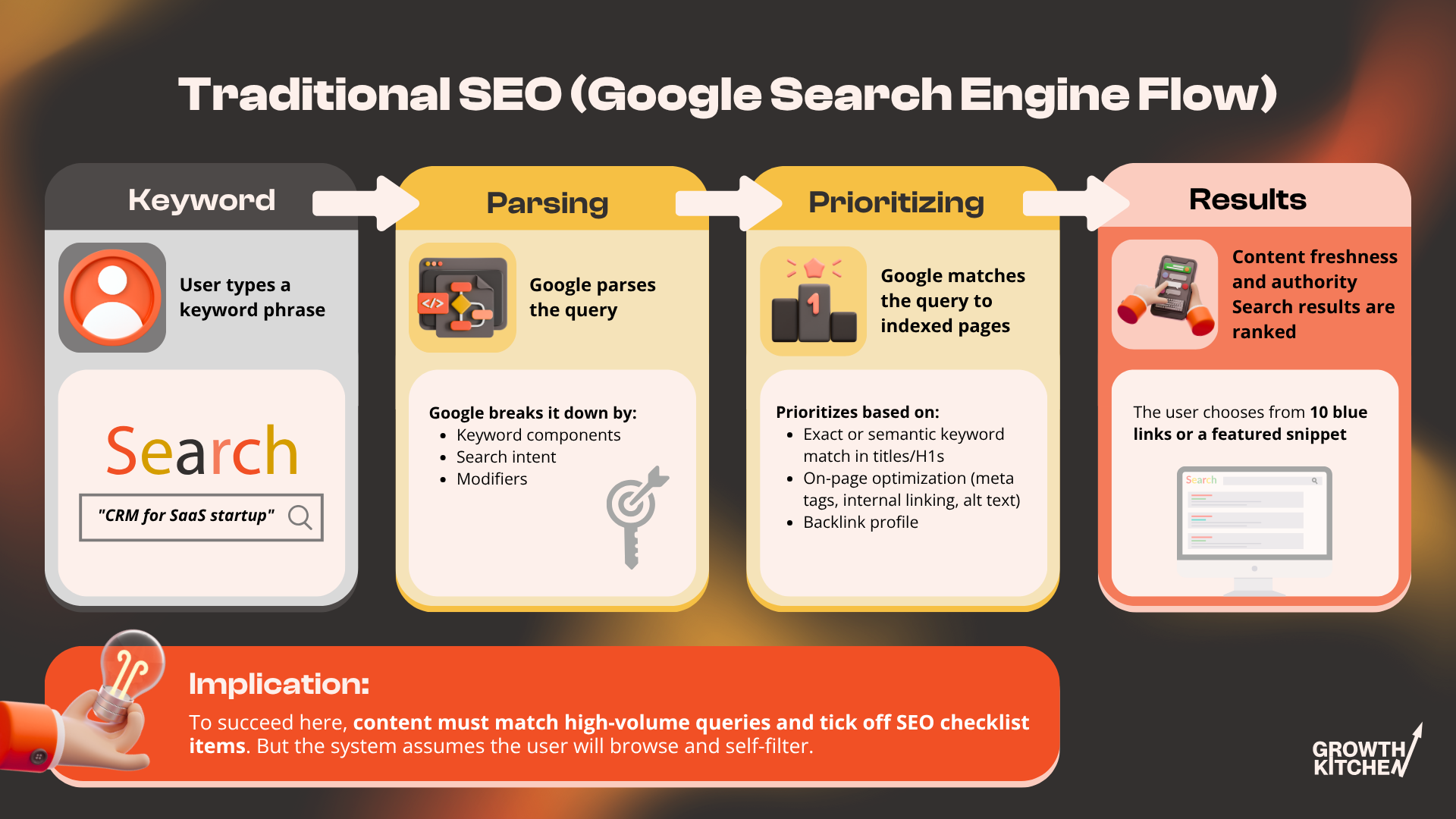
To win real visibility, you need a strategy that accounts for how AI models find, interpret, and generate content. That means not canceling traditional SEO, but thinking beyond search rankings and optimizing for mentions, semantics, and content ecosystems. In my experience, the companies adapting fastest to this shift are the ones earning both human trust and LLM relevance.
Now let’s answer your main question: How to build SaaS content strategy that actually drives pipeline and ranks in AI search?
A Good SaaS Content Marketing Strategy for LLMs
Define Your ICP with LLM Behavior in Mind
Back when we were optimizing content creation strictly for Google, defining your Ideal Customer Profile (ICP) was about alignment. You needed to understand your buyer’s pain points so you could create a piece of content around the keywords they might search: “best CRM for startups”, “how to reduce churn in SaaS”, or “top email marketing tools.” The assumption was simple: your ICP would type questions into a search box, and your job was to match the language.
That’s still true, to a certain degree, as LLMs have shifted the rules.
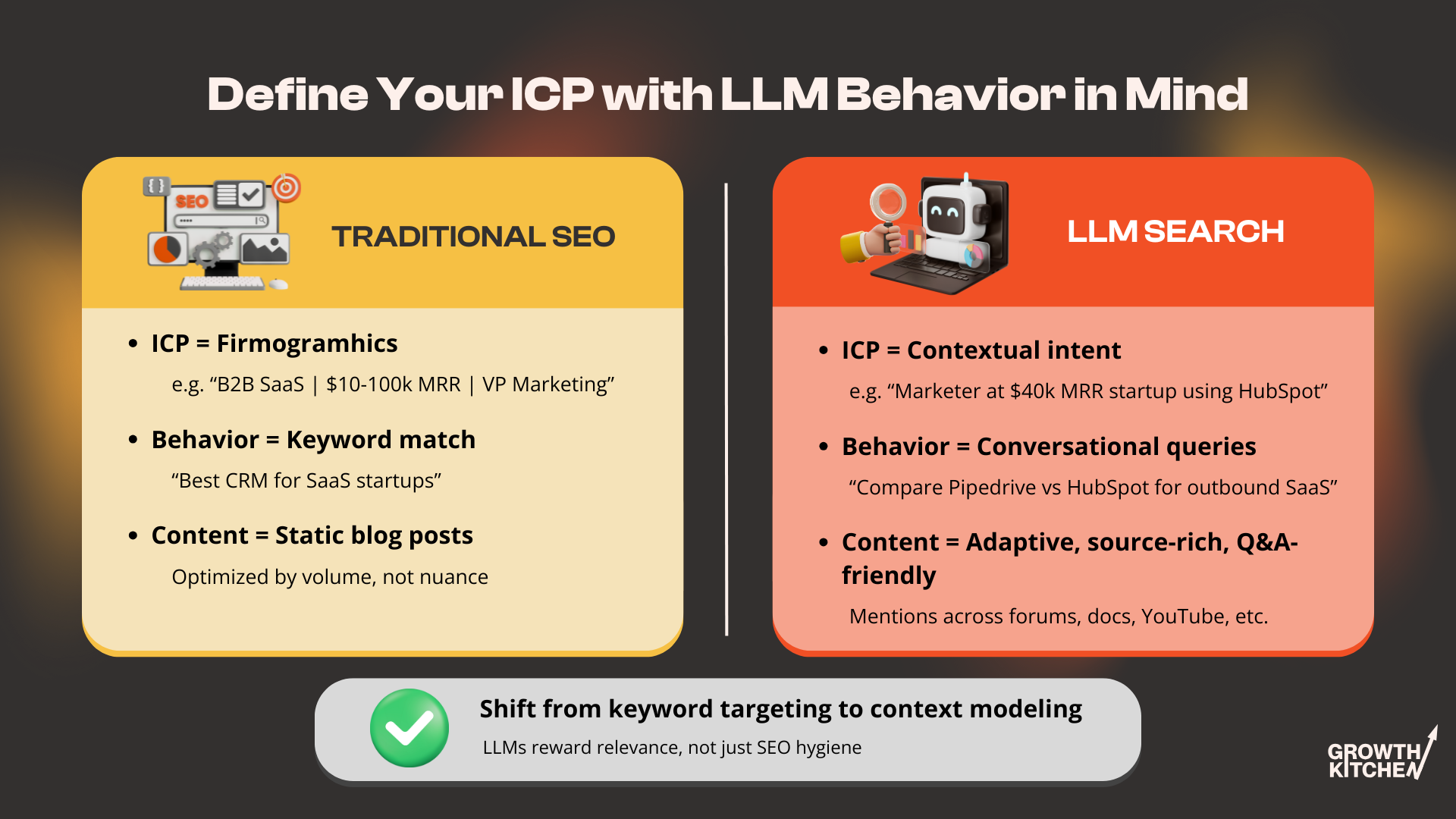
Your buyers aren’t searching anymore — they’re asking. And the way they ask questions is more natural, more context-rich, and more layered. Instead of looking for a list of tools, they might say:
“What’s the best CRM for a startup with a small sales team and limited technical resources?”
Or even:
“Compare HubSpot, Pipedrive, and Close.io for an early-stage B2B SaaS with outbound focus.”
These queries aren’t about keywords; they’re about intent, specificity, and situation, and LLMs are trained to answer exactly that.
That means your content production needs to reflect how your ICP thinks in context, not just in search terms. It also means we need to define ICPs based not only on firmographics (industry, size, ARR) but also scenario-based behavior:
- What kinds of questions are they asking in AI tools?
- What problems are they troubleshooting mid-funnel?
- What edge cases or comparisons do they need help understanding?
In our client strategies, we’ve started mapping ICP behavior by combining user interviews, sales call transcripts, and tools like Perplexity search history or Firecrawl crawls of competitor support forums. The goal is to build a question-level understanding of what the ICP wants, and then structure content that addresses it.
! In b2b content marketing, it’s no longer enough to say “We target B2B SaaS founders.” You need to know what that founder is typing into ChatGPT at 11 p.m. before their next board meeting.
Align Content Marketing to Questions, Not Just Keywords
When I started in SaaS content marketing, our content marketing plans were built around keywords (spreadsheet rows filled with monthly volume, competition scores, and exact-match phrases). We’d plan around terms like “CRM software for startups” or “email onboarding best practices.” And to be honest, such a content calendar worked for a long time, especially in Google’s page-by-page ranking system.
But as you already know, LLMs don’t care about keywords. They care about questions.
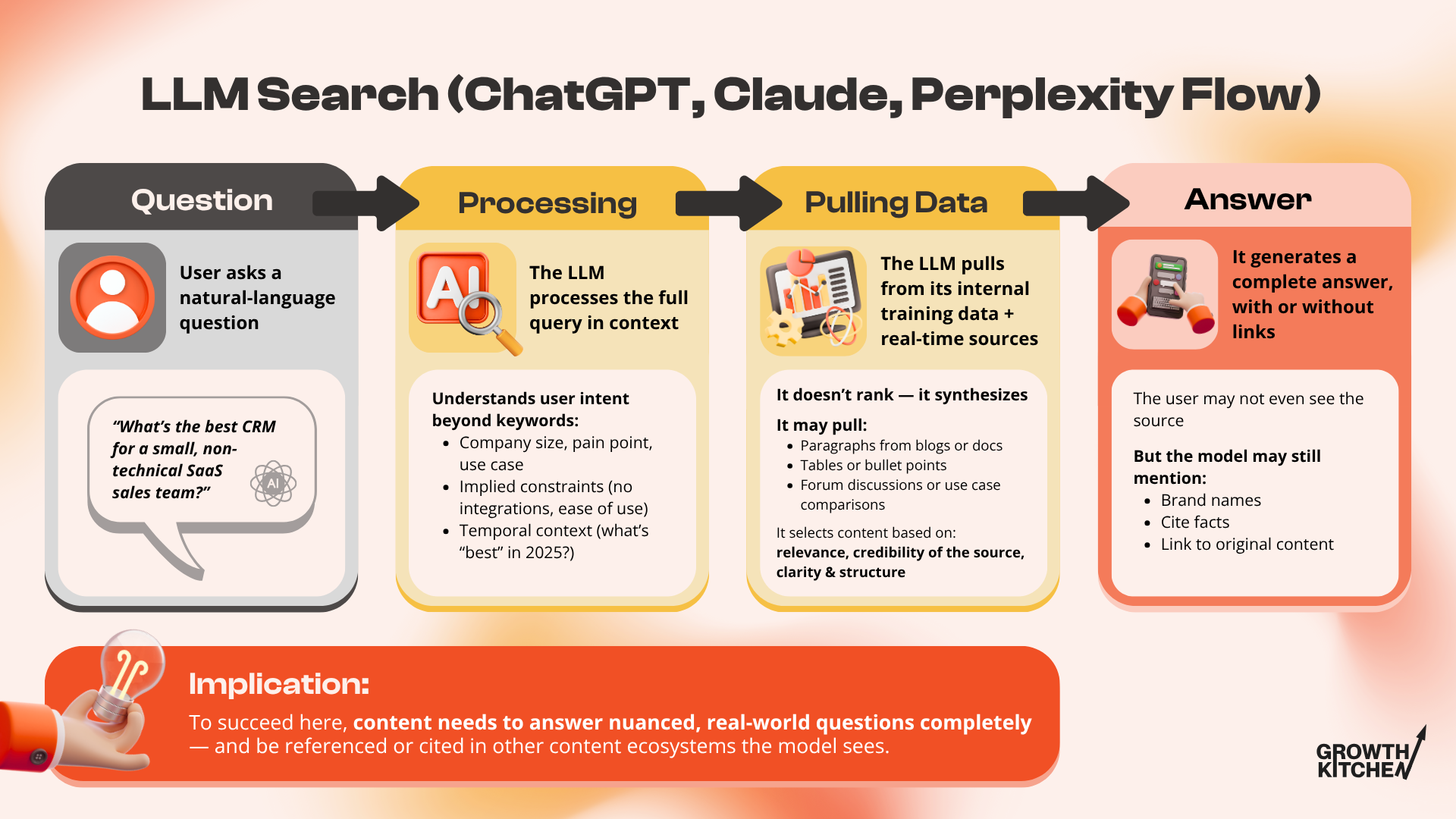
Let me explain even more. When someone asks ChatGPT a question like:
“What’s a good CRM for a 5-person sales team that doesn’t need custom integrations?”
the model doesn’t pull exact-match results. It synthesizes an answer from multiple sources (blog posts, docs, reviews, forums) that collectively answer the question.
So if you create content around keyword strings instead of real questions your ICP is asking, you’re invisible. And what’s worse — even if you’re indexed, you’re not cited.
What to Do Instead
Start with questions.
Use sales calls, support logs, Reddit threads, and Perplexity search suggestions to find the real questions your ICP is asking. Not just:
- “CRM for SaaS”
but:
- “Best CRM for a non-technical SaaS founder”
- “Can you use Notion as a CRM for small B2B teams?”
- “Is HubSpot worth it for <$50k MRR?”
Then, structure your content formats to answer those questions directly.
Use clear H2s and intros.
LLMs love semantically clear structure. Your article shouldn’t hide answers deep in the fluff; it should clearly put them on the surface. A clear headline like:
“Is HubSpot Worth It for Startups Under $50k MRR?”
gives both humans and LLMs a clean entry point.
Answer fully, not just briefly.
Too many SaaS blogs give narrow answers, then jump to a CTA. That’s a missed opportunity. If you don’t answer thoroughly, an LLM won’t quote you. Instead, it will pull from someone who did.
Incorporate E-E-A-T Into Your SaaS Content Strategy
Back when E-E-A-T (Experience, Expertise, Authoritativeness, and Trustworthiness) was first introduced by Google, it felt like a checklist for regulated industries like YMYL sites, medical blogs, and fintech startups. But today, E-E-A-T has become foundational for all content that hopes to rank both in search engines and LLMs.
It works this way because language models don’t trust content by default. They evaluate it probabilistically based on the credibility of signals across your site and your broader presence.
If your blog post is cited in forums, your author has a clear profile, and your website emits structured trust signals, LLMs are far more likely to include your content in generated responses.
I’ve seen technically weaker content marketing efforts outrank or out-cite stronger pieces in LLM answers, simply because it did a better job showing who wrote it, why it matters, and where else it was trusted.
Why E-E-A-T Matters for LLMs
LLMs “choose” content based on how credible, human, and useful it seems.
- It’s written by someone real and experienced
- It comes from a trusted source
- It’s structured in a way that is clear, complete, and useful for the query
E-E-A-T Best Practices for SaaS Content
| Pillar | Tactical Practice | How It Helps LLM Discovery |
| Experience | Add real product screenshots, customer quotes, or personal insights | Models detect firsthand experience — boosts credibility and uniqueness |
| Expertise | Publish under named authors with relevant bios (LinkedIn-linked ideally) | Gives the model metadata to associate content with real expertise |
| Authoritativeness | Get cited in third-party forums, niche communities, industry roundups | External signals of reputation are deeply valued by LLMs |
| Trustworthiness | Use HTTPS, clear privacy policies, and no pop-up spam | Improves crawlability, trust scoring, and user-perceived safety |
| Structured Data | Use schema markup | Helps models parse who wrote it, for whom, and what the page is about |
Quick Note on Schema Markup (The Tech Part)
Schema markup is code you add to your site’s HTML to help search engines and LLMs understand your content contextually. For E-E-A-T, you should add:
- Article or Blog Post schema → to structure the content itself
- Person schema → for author info (name, title, links, bio)
- Organization schema → company details and identity
- FAQ schema → for question-answer formatted pages
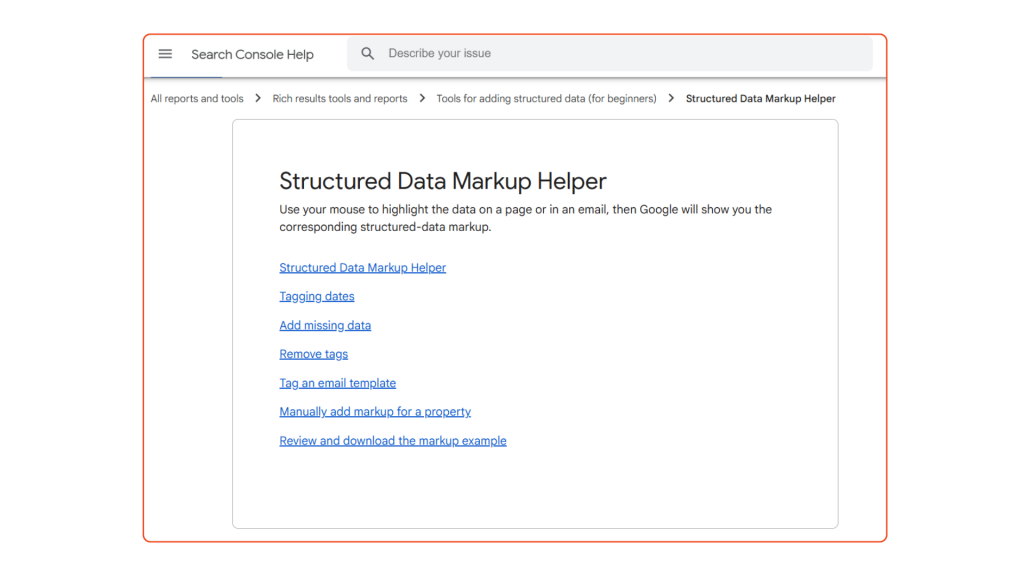
You can use Google’s Structured Data Markup Helper or tools like Rank Math (WordPress) or Schema Pro to implement it without writing code manually.
What LLMs Look At: Choose Smart Content Formats
1. Depth and Structure Beat Volume
Publishing 20 thin posts a month won’t help if none of them answer a question in full. Instead, focus on long-form, high-quality content that breaks down a topic thoroughly. LLMs favor sources that resolve user intent in one sitting — not ones that bounce readers around.
2. Create Source-Worthy, Authoritative Assets
Ask yourself: Would an expert link to this? Would an AI quote this?
That’s the bar. To reach it, prioritize unique POVs, primary research, detailed case studies, and product-specific breakdowns. The more your content contributes to the broader knowledge ecosystem, the more likely LLMs are to surface it.
3. Organize for Scannability and Semantic Clarity
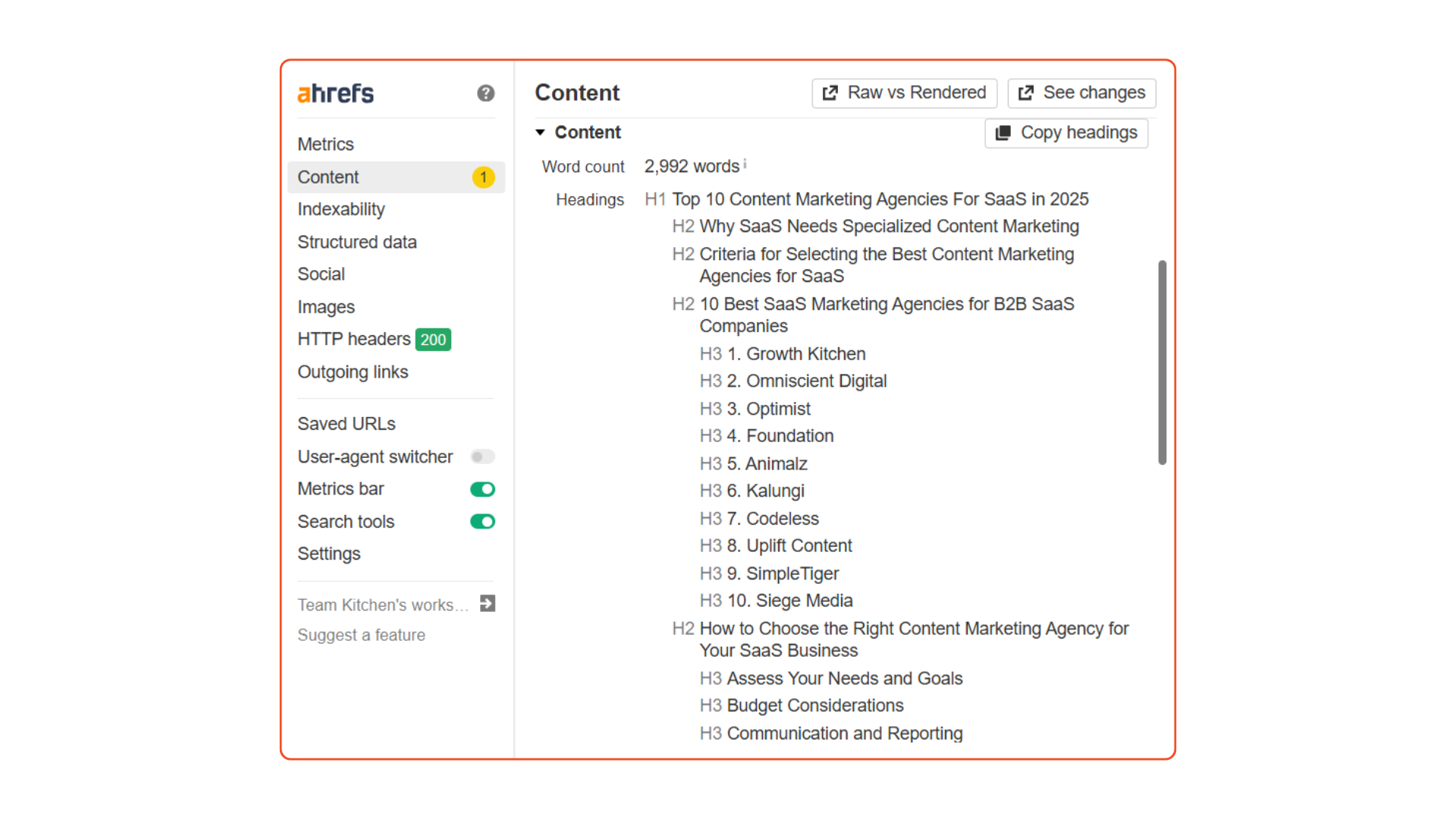
LLMs rely on structure to understand and synthesize content. Use clear subheadings (H2/H3), ordered lists, clean formatting, and consistent terminology. Avoid bloated intros and “SEO filler.” Your goal is to make it easy for both models and humans to extract what matters. Use Ahrefs to analyze and improve the structure of your content.
How to Know If LLMs Are Quoting Your Content
Track Visibility in AI Tools and Assistants
LLMs don’t leave referral traces — but you can still spot when they’re surfacing your content.
Try this workflow regularly:
- Ask ChatGPT, Claude, or Perplexity real questions your ICP would ask.
- Review the answers: Are your blog posts, guides, or domains cited or paraphrased?
- In Perplexity, look at the source cards — they often link to actual URLs.
- For ChatGPT with browsing or plugins enabled, look for anchor mentions in footnotes.
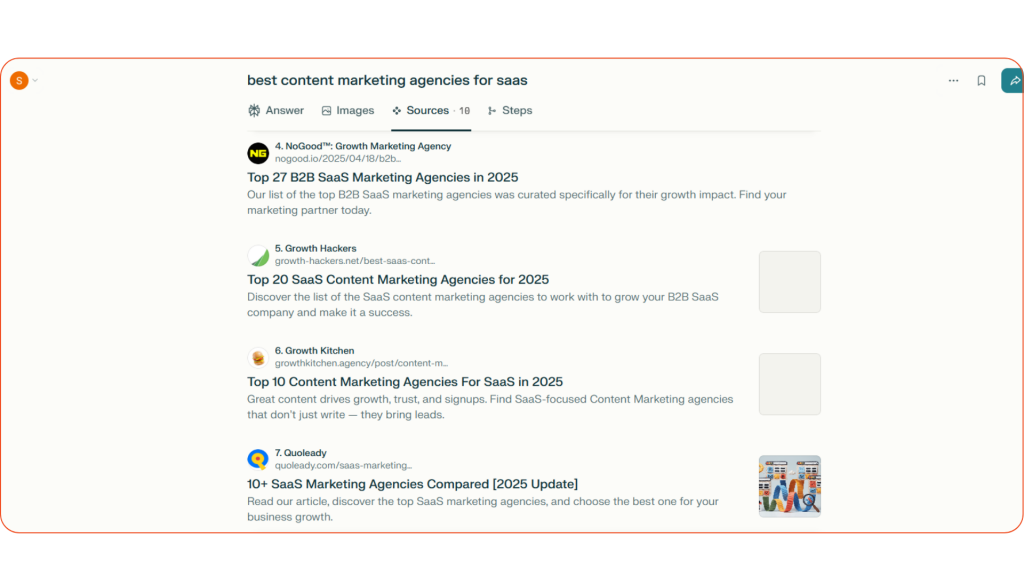
Tip: Maintain a list of strategic queries and audit monthly to track shifts in exposure.
Use Modern Analytics
Since LLM traffic doesn’t show up in GA4 as a clear source, use indirect signals and smarter tracking:
- Branded search trends: Look for spikes in impressions or CTR via Google Search Console.
- Direct traffic anomalies: Unexplained surges often come from AI tools.
- Custom UTM tagging: Add unique UTMs in your top articles’ CTAs — if those get shared or cited, you’ll catch secondary clicks.
- Session recordings (via PostHog or Hotjar): Look at behavior on content-rich pages to detect if visitors are arriving mid-funnel, bypassing your homepage.
Tools to explore: PostHog, Search Console, SparkToro, Segment, Perplexity Pro
Monitor Brand Mentions and AI Referrals
Your brand may be quoted in answers even if it’s not linked. That’s why you should monitor:
- Brand and author name mentions across forums, Reddit, Quora, Substack, and newsletter databases
- Tool roundups and curated lists that LLMs often scrape and echo in answers
- Social reposts of AI responses (e.g., users sharing ChatGPT screenshots that reference your brand)
Pro move: Add an optional “How did you find us?” dropdown in demo or signup forms with an option like “AI tool (e.g., ChatGPT, Perplexity)” — you’ll be surprised how often it gets picked.
2025 Trends in SaaS Content Strategy for AI Search To Implement
Product-Led Content as the New Pillar
LLMs prefer content grounded in real experience. In-depth, hands-on content about your product (not just generic advice) is more likely to be seen as credible and useful.
Tactics:
- Build feature-focused use cases (e.g. “How to automate lead scoring with [Product]”) written by your own team or power users.
- Create “how we use our own product” posts to signal authenticity and firsthand experience (E-E-A-T + topical authority).
- Include real screenshots, workflows, and limitations — avoid stock visuals.
- Publish lightweight product docs as content assets (LLMs often pull from clear documentation).
Community Signals and UGC for LLM Credibility
LLMs crawl the ecosystem. If your brand is discussed on Reddit, mentioned in a curated list, or reviewed on G2, it becomes part of the model’s mental map. Community mentions ≠ backlinks, but they’re powerful.
Tactics:
- Encourage users to share mini case studies or “how I use this tool” posts on LinkedIn, Reddit, or Medium.
- Launch a public Notion hub or forum where users can submit workflows, templates, or hacks.
- Collaborate with influencers or micro-creators to create authentic, product-focused walkthroughs (text or video) in niche channels.
- Engage in threads where competitors are already being mentioned — position your solution as the alternative with a human touch.
Privacy, Zero-Party Data, and Trust Signals
Privacy-first content builds trust with users and LLMs. Trustworthiness is a key LLM ranking factor. Zero-party data helps you create content that feels personalized without violating privacy norms.
Tactics:
- Embed interactive tools (e.g. checklists, calculators) that offer value while collecting user input transparently.
- State clearly what data you collect (and don’t collect) in your content CTAs and forms — this transparency can be echoed in citations.
- Build content hubs gated by intent (not forms) to demonstrate value-first thinking and user control.
- Add trust layers: author bios, updated timestamps, source citations, HTTPS, and minimal cookie banners.
TL;DR: The SaaS Content Strategy for LLM SEO You Need (2025)
| Step | What to Do | Why It Matters |
| 1. Define Your ICP by Questions, Not Segments | Use tools like Perplexity, Firecrawl, and sales logs to find real AI-style queries | LLMs rank answers to real-world, context-rich questions |
| 2. Align Content Around Questions | Use H2s that mirror queries. Don’t bury the answer. | LLMs extract structured, direct, helpful content |
| 3. Humanize for EEAT | Add author bios, real examples, citations, and schema markup | Trust, credibility, and transparency boost LLM citations |
| 4. Choose Smart Content Formats | Create deep guides, product-led walkthroughs, and source-worthy insights | LLMs prefer depth + originality over keyword-stuffed fluff |
| 5. Track LLM Visibility Indirectly | Monitor brand mentions, use UTM tagging, and audit Perplexity results | Traditional analytics won’t show AI referrals — you need proxies |
| 6. Activate Community Signals | Get users to talk about you on Reddit, forums, Substack, and Twitter | LLMs scrape community sources — these become inputs to citations |
| 7. Build Trust with Privacy and Transparency | Be upfront about data use and gate content with intent, not forms | Builds trust signals for both users and models |
| 8. Update Your Content Engine | Prioritize clarity, citations, and ecosystem relevance — not just keyword density | This is how you show up inside LLM responses — not just Google |
Final Thoughts: Build for Humans, Optimize for Machines
If you want to drive qualified pipeline, be cited by AI tools, and turn content into a true growth engine, you need more than just good writing. You need a system, structure, and content distribution strategy built for how today’s buyers actually discover and trust SaaS brands. And if you can’t do it all in-house, you need a B2B SaaS marketing team that can.
At Growth Kitchen, we specialize in content-led SEO for SaaS companies with product–market fit.
We’ve helped teams like yours turn overlooked content into high-converting funnels — and get cited in places traditional SEO tools can’t even track.
What we bring to the table:
- AI-optimized content strategy that ranks in both Google and LLMs
- Deep ICP research and query mapping
- Full-funnel content creation with EEAT and conversion baked in
- Technical SEO, analytics, and ongoing performance optimization
- Real results: leads, signups, and discoverability in places you can’t buy ads
Want to see what this could look like for your SaaS?
Grab a free AI SEO Snapshot — we’ll audit your current content, surface hidden LLM and BOFU opportunities, and show you what to fix first.
Let’s make your SaaS SEO content unskippable for both humans and AI!
FAQ: Building a B2B SaaS Content Strategy That Drives Signups in 2025
-
The most effective SaaS content strategy for LLM visibility is one that focuses on creating valuable content designed to answer specific, real-world questions from your ICP. It’s no longer just about keyword stuffing. It’s rather about producing targeted content that LLMs can interpret as helpful, credible, and contextually rich.
To do this, you need a robust content strategy built around:- Educational content at every stage of the marketing funnel
- A mix of bottom of the funnel content (BOFU), middle of the funnel content (MOFU), and top-of-funnel value
- Strategic content distribution across channels LLMs scrape (Reddit, forums, docs)
This approach helps you and your content marketers build trust and credibility, improve AI-based discoverability, and ultimately create a SaaS content strategy that drives signups and conversions.
-
LLMs like ChatGPT don’t leave referral traces, so you’ll need indirect methods to track usage. Monitor brand mentions in AI outputs (especially in tools like Perplexity), check for unexplained direct traffic spikes, and listen for prospects who mention finding you via “an AI.”
Using a content strategy that drives visibility, you can also audit whether your marketing content is being cited or paraphrased in AI responses. Maintaining great content performance that lives in trusted ecosystems (Substack, documentation pages, Reddit threads) increases your chance of appearing in AI summaries.
This kind of content marketing for SaaS businesses isn’t just for visibility — it’s how you build content that drives both awareness and signups.
-
The formats that perform best for LLM discovery and ranking are those that prioritize clarity, usefulness, and content that answers questions directly. That means:
- Long-form educational types of content
- Well-structured blog posts with clear H2s and semantic formatting
- Use-case driven marketing content
- Product-led tutorials and explainers
- FAQ sections and knowledge base content
LLMs prefer great content marketing that reads naturally, cites trustworthy sources, and addresses specific queries. To succeed, create a SaaS content strategy that includes both TOFU and quality content for each stage of the funnel, including bottom of the funnel content that resonates and drives real conversions.
-
Traditional SEO strategies focus on ranking in Google’s search engine results by optimizing for keywords, backlinks, and on-page factors. In contrast, LLM SEO is about creating content that converts into AI-generated answers. There are no SERPs except answers.
To adapt, you need to:
- Create a content marketing strategy based on real queries, not just keyword volume
- Focus on creating valuable content that’s cited across ecosystems
- Produce effective SaaS content that’s structured and helpful
This means building a b2b SaaS content marketing engine that doesn’t just chase keywords but produces content to help real users and shows up across trusted sources LLMs train on.
-
E-E-A-T (Experience, Expertise, Authoritativeness, Trustworthiness) is a key signal for LLMs to determine what content to surface. It affects whether your marketing content is seen as credible or ignored.
To boost your E-E-A-T:
- Add author bios and real company context
- Include screenshots, data, and real-world examples in your content marketing campaign
- Use schema markup and create a SaaS content hub with content that answers specific user needs
Strong E-E-A-T helps you build a content moat that earns citations and reinforces the success of your content marketing in both search and AI.
-
While LLMs don’t show up in Google Analytics, you can track impact through:
- Increases in branded search volume
- Demo or signup form fields asking “How did you find us?”
- Tracking inbound links and mentions via tools like SparkToro or Brand24
When you create a SaaS content engine that gets cited, it will often drive invisible traffic, until users tell you. This is why effective content marketing should be paired with modern tracking tactics.
You still need to create content for attribution, but also to build trust and credibility that lives beyond the SERP — in AI interfaces, tool roundups, and human conversations.


Let us know more about your company
To see how Growth Kitchen can scale your SaaS